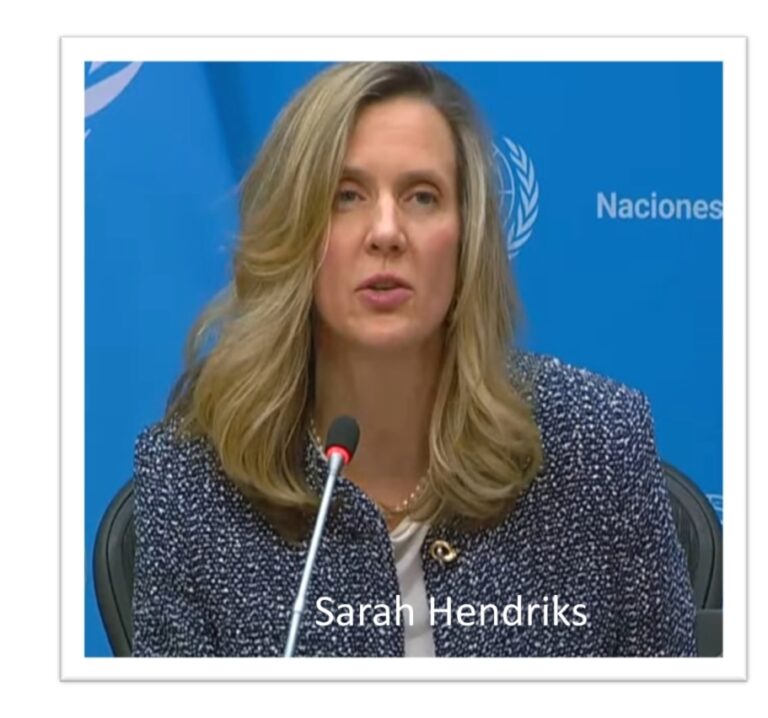



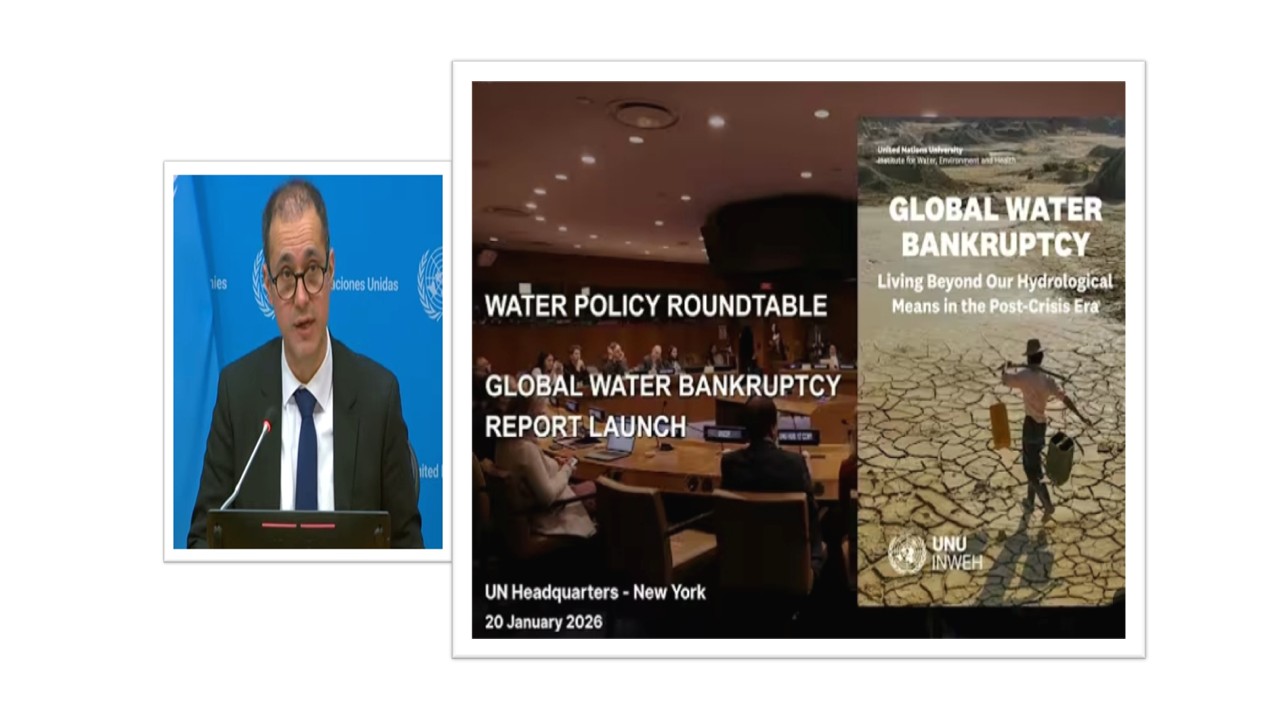
Prof. Kaveh Madani, Director of the UN University’s Institute for Water, Environment and Health (UNU-INWEH) and lead author expose a report entitled Global Water Bankruptcy: Living Beyond Our Hydrological Means in the Post-Crisis Era, to reporters in New York. This report, published on the 30th anniversary, declares the world has entered global water bankruptcy’ era, calling for a fundamental shift in how global community understands water as the most vital resource.
The report outlines a transition from Crisis Management to Bankruptcy Management which requires a new global agenda with following important items to be seriously noted:
- The truth is to acknowledge irreversible losses. It consequently effects to protect remaining capital by stopping making development promises that hydrology cannot keep.
- To prioritize prevention of further damage on remaining ‘savings’ which are the aquifers and ecosystems that are still functional around the world.
- To decouple growth from water. Principally, by moving away the using economic prosperity’s assumption, which requires ever-increasing water withdrawals.
Prof. Madani said this report is a diagnosis of water condition on the world scale where in many basins, the old normal is already gone. The fact says nearly three-quarters of the world’s population lives in countries classified as water-insecure or critically water-insecure. Over 2 billion people still lack safely managed drinking water, 3.5 billion lack safely managed sanitation, and about 4 billion people experience severe water scarcity for at least one month each year. Though it is not a warning about the future we might still avoid everywhere.
The meaning of ‘bankruptcy’ used in this report’s title is practical terms, a combination of insolvency and irreversibility. Insolvency means withdrawing and polluting beyond renewable inflows and safe depletion limits. Irreversibility means key parts of man-made damaged to water-related natural capital—aquifers, wetlands, soils, rivers, lakes, and glaciers—in ways that are not realistically reversible on human time scales or would be prohibitively costly to restore.
This explanation shows persistent failure in a state where water systems can no longer realistically return to their historical baselines. This is a condition called Global Water Bankruptcy, which requires a collective act, because it is a justice and security issue. The costs of this hydrological overshoot fall disproportionately on those who can least afford it like smallholder farmers, indigenous communities, and urban poor. Prof. Madani warned should normal management practice with stress on temporary failures only, or short-term crises’ fixes continue, a worsening scenario may happen, it will deepen the ecological damage and fuel social conflict.
__________________________________________________________________________
Kaveh Madani, Director of the UN University’s Institute for Water, Environment and Health (UNU-INWEH) and lead author of the report entitled “Global Water Bankruptcy: Living Beyond Our Hydrological Means in the Post-Crisis Era”.
—– A new flagship report declared that the world has entered the era of Global Water Bankruptcy, calling for a fundamental shift in how the global community understands the most vital resource – water.
Related link
Global Water Bankruptcy Report Discussion at UN Water Policy Roundtable | United Nations
Watch the “Water Policy Roundtable and the Launch of the Global Water Bankruptcy Report”
Global Water Bankruptcy Report – Press Conference | United Nations