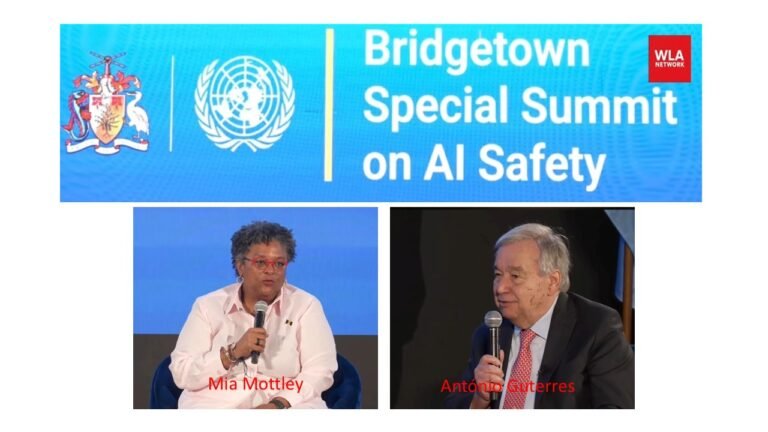



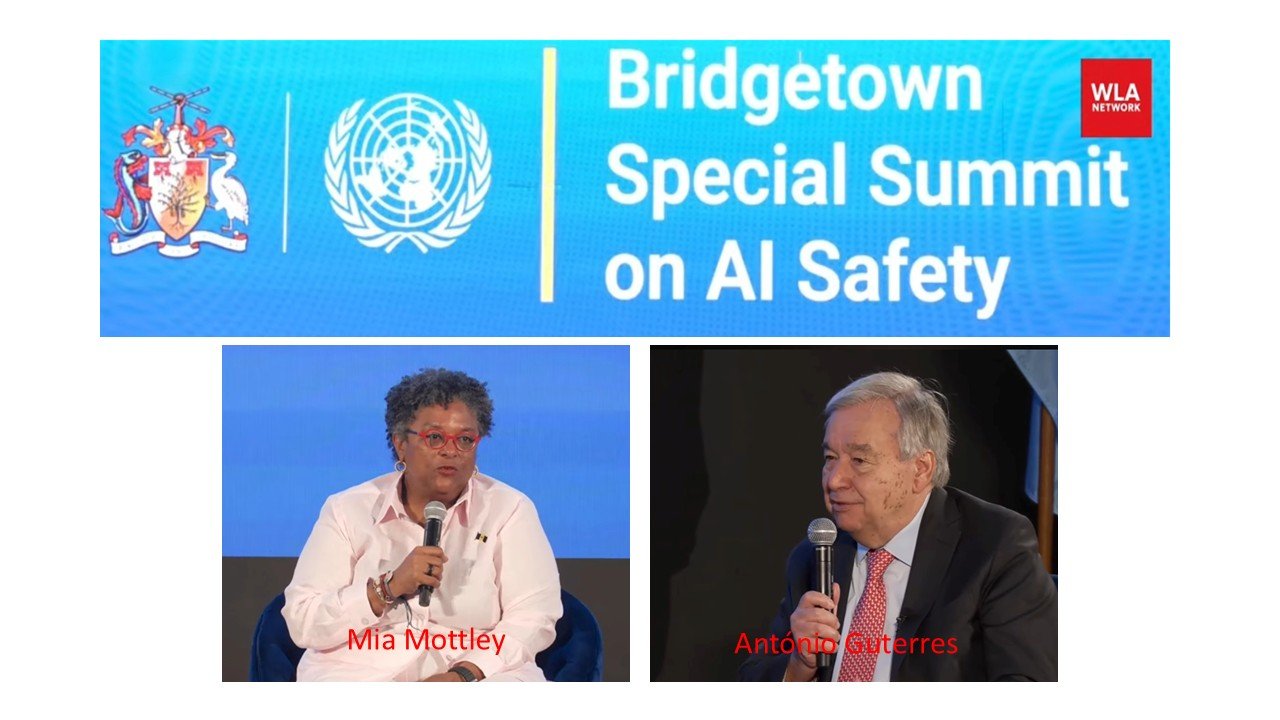
At the Bridgetown Special Summit on AI Safety in Barbados, UN Secretary-General António Guterres and Barbados Prime Minister Mia Mottley argued that AI governance must be inclusive, grounded in science, and shaped for the benefit of all humanity.
The UN’s Case for Inclusive AI Governance
The Secretary-General stressed that the UN is uniquely placed to oversee AI because it is the only entity that represents every nation. He proposes a multilateral framework for AI risk management, supported by independent and credible oversight. The UN can draw on its experience in sectors such as nuclear energy, aviation, and telecommunications, though AI will need a customized approach. Key elements include:
- Independent science: Governance should rest on independent expertise, such as the international scientific panel on AI.
- A bottom-up approach: Civil society should be empowered to act as a counterweight to the concentrated power of private entities.
- Inclusive oversight: Rules should move away from a “club” model, in which a few powerful countries and companies dictate terms, toward a fully inclusive multilateral framework.
How the UN Supports Smaller and Developing Nations
The Secretary-General and Prime Minister Mottley described several mechanisms to make AI governance inclusive and effective:
- Capacity building: The UN has set up a global network for exchange and cooperation on AI, which already includes 27 centres of excellence across five regions. The Secretary-General has also proposed a global fund for AI capacity building to help countries govern and evaluate digital technology.
- Multilateral oversight: Independent, multilateral risk management gives every country a voice in shaping global rules.
- Localized solutions: Barbados is developing its own language models based on local culture and ways of life, so that AI services are not discriminatory and serve local needs.
Why the “Club” Approach Falls Short
Both leaders consider the club approach problematic for four reasons:
- Lack of inclusivity: AI affects everyone, yet a club limits decisions to a small group of countries and corporations and excludes most nations.
- Deepening inequalities: Prime Minister Mottley argues that it produces “one-size-fits-all” prescriptions that hamper smaller nations and risk marginalizing them further.
- Concentration of power: The Secretary-General sees it as part of a dangerous transfer of power from states to a few private entities, one that traditional global institutions are not equipped to handle.
- Lack of legitimacy: The UN is the only body with the legitimacy to govern a technology that affects the entire world; exclusive clubs lack that representative authority.
Risks for Small States
In her opening remarks, Prime Minister Mottley emphasized that small states must have a voice in shaping the rules governing AI. She warned that without inclusion and safety, developing nations face significant risks:
- Existential crises: These include the climate crisis, the struggle to maintain sovereignty, the socioeconomic divide caused by unchecked AI, and global inequality that fuels instability.
- Concentration of power and wealth: Without guardrails, AI could create a “feudal overlordship” in which wealth and computing power are held by a few, leaving small states further marginalized.
- Discriminatory responses: Small nations often start with lower literacy levels and disparities in computing power. Without localized language models and inclusive development, AI may produce responses that do not “see, hear, or feel” their cultures and realities.
- Loss of sovereignty: If international rules are not shaped collectively, small states may have to adapt to “one-size-fits-all” prescriptions that hamper development and compromise their sovereignty.
- Deepening global inequality: AI threatens to widen existing digital and economic divides rather than bridge them, which can lead to social instability.
Prime Minister Mottley therefore calls for collective international action to ensure that AI serves all of humanity rather than reinforcing existing disparities.
Climate and Development Finance Reform
The remarks also referred to an initiative to reform development finance, with three aims:
- Transforming development finance: Change how the world approaches development finance, particularly how wealthier nations can help developing countries cope with and adapt to climate change.
- Improving resilience: Lower the costs of climate mitigation and adaptation for developing nations without adding to their debt burdens.
- Urgent global reform: Modernize financial systems designed for an earlier era so they can address contemporary challenges such as the climate crisis.
Related link:
António Guterres at Bridgetown Special Summit on AI Safety
Barbados PM & UN Chief Send SHOCKWAVES! Warn of GLOBAL AI POWER GRAB | WLA